HIPAA Compliance Services
Securexocean's HIPAA compliance services help covered entities and business associates implement, document, and validate the administrative, technical, and physical safeguards required under federal law.
What Is HIPAA Compliance
The Health Insurance Portability and Accountability Act establishes enforceable federal standards governing how Protected Health Information is stored, transmitted, accessed, and disclosed. Non-compliance carries civil and criminal penalties ranging from $100 to $1.9 million per violation category, enforced by the HHS Office for Civil Rights.
Securexocean's HIPAA compliance program combines gap assessment, policy development, controls implementation, and audit preparation into a structured engagement. Our team works directly with your clinical, technical, and operational stakeholders to translate regulatory requirements into operational controls that hold up under OCR scrutiny.

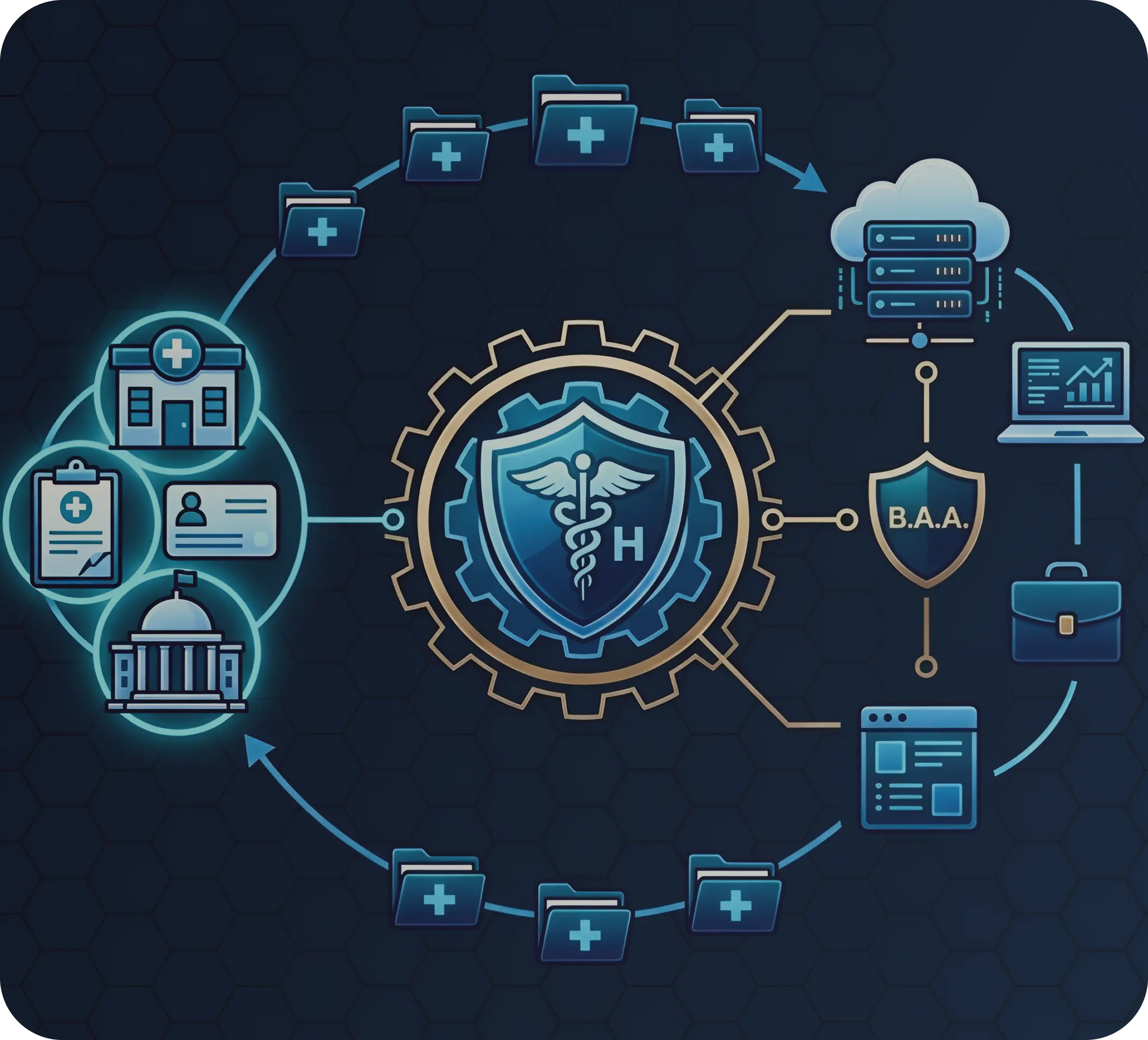

Healthcare providers, health plans, and healthcare clearinghouses that create, receive, maintain, or transmit PHI in any electronic form. This includes hospitals, clinics, insurers, HMOs, and government-funded health programs.

Third-party vendors, technology providers, billing companies, cloud storage providers, and consultants who encounter PHI while performing services on behalf of a covered entity. Business Associate Agreements are mandatory for all qualifying vendor relationships.
HIPAA Regulatory Framework
Establishes patient rights over their PHI and governs permissible uses and disclosures. Applies to covered entities and defines conditions under which PHI may be shared without patient authorization.
Mandates administrative, technical, and physical safeguards specifically for electronic PHI. Requires covered entities and business associates to implement access controls, encryption standards, audit logging, and workforce training programs.
Requires covered entities to notify affected individuals, HHS, and in some cases media outlets within 60 days of discovering a breach involving unsecured PHI. Business associates must notify covered entities within the contractually defined timeframe.
We engage your clinical, IT, and compliance stakeholders to determine covered entity or business associate classification, map PHI data flows across systems and vendors, identify all technologies and applications involved in PHI processing, and define the precise scope of your compliance program.
Our team conducts a detailed HIPAA risk assessment to identify vulnerabilities in your PHI environment. We develop and document required policies and procedures including Information Security Policy, Data Protection Policy, Privacy Statement, Cyber Crisis Resiliency Program, and Incident Management Procedure. Administrative, technical, and physical safeguards are then implemented or validated against HIPAA Security Rule requirements.
We build a centralized compliance framework that operationalizes HIPAA processes into daily workflows. This includes data subject request management procedures, consent tracking mechanisms, breach notification workflows mapped to HIPAA timelines, and a structured audit trail repository enabling continuous compliance demonstration.
A comprehensive HIPAA compliance audit validates all implemented safeguards against the Privacy, Security, and Breach Notification Rules. We produce a compliance status report identifying residual risks and corrective actions, and establish your Annual HIPAA Audit Plan to maintain regulatory readiness year over year.

Formal HIPAA risk assessment report with identified vulnerabilities and prioritized remediation guidance

Complete documentation package covering all required HIPAA policies and procedures

Controls implementation guidance mapped to administrative, technical, and physical safeguard categories

Business Associate Agreement templates and vendor management framework

Breach notification procedure documentation aligned to 60-day OCR reporting requirements

Annual audit plan framework for sustained compliance maintenance
FREQUENTLY ASKED QUESTIONS

Securexocean delivers end-to-end HIPAA compliance services for covered entities, business associates, and healthcare technology providers operating in regulated environments.

Enterprise-grade VAPT, GRC advisory, compliance consulting, and AI-assisted threat management for modern businesses.


© 2026 Securexocean. All rights reserved.